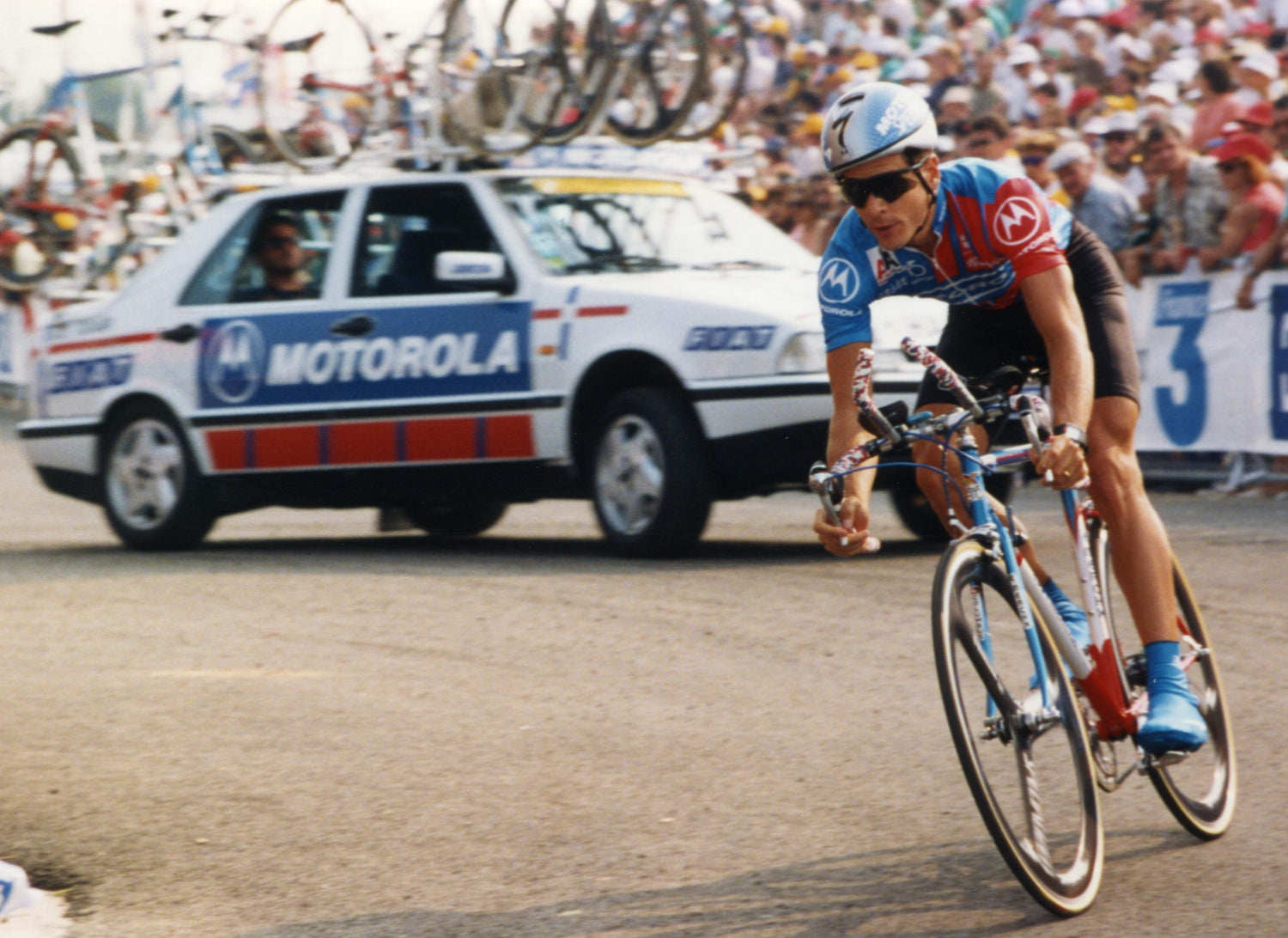
The Tour de France peloton of 1986 had absorbed a lot across its eight decades: war interruptions, doping hiding in plain sight, sponsors with no connection to cycling whatsoever — banks, fertilizer brands, insurance companies with something to prove. It had not, until that summer, absorbed a team sponsored by a convenience store.
Team 7-Eleven rolled in from America with eight U.S. riders, one Canadian, one Mexican, and the collective presumption of a country that had only just started taking road cycling seriously. Europe found this amusing. Then Andy Hampsten and Ron Kiefel won stages at the Giro d'Italia in the spring, and the amusement curdled into something more respectful.
Jim Ochowicz, the team's founder, had built 7-Eleven from scratch in 1981, understanding that American riders could compete if someone gave them the infrastructure to do it. The Europeans, for all their tradition, had never had a monopoly on suffering. The Americans could suffer fine.
That team seeded everything that followed. Greg LeMond won the Tour de France in 1986, 1989, and 1990, the only American to have done it without an asterisk. Andy Hampsten won the 1988 Giro d'Italia with one of the race's most mythologized performances: alone in a whiteout blizzard over the Gavia Pass, a climb so brutal that most of the peloton was simply trying to survive it, while Hampsten was building a gap. The infrastructure Ochowicz built became the template for every American team that followed.
Then came a longer, louder chapter. The US Postal Service team, Lance Armstrong, seven Tour de France titles, all of them later stripped after one of the sport's most consequential doping investigations. That story has been told at length and belongs somewhere else. The structural consequence is what matters here: American corporate interest in cycling dried up, the appetite for team sponsorship retreated, and when BMC Racing, the last serious U.S.-backed WorldTour outfit, lost its title sponsor and dissolved at the end of 2020, nothing came to fill the space.
The WorldTour, for those outside the sport, is cycling's top division. Eighteen teams. The biggest races: the Tour de France, the Giro d'Italia, the spring Monuments. To race at that level, you need a team. America had those teams, for a while, and then it didn't.
Six years on from BMC's dissolution, America has fourteen riders at the WorldTour level. Fourteen. More than any era, including the years when American teams were actively trying to build depth. Brandon McNulty is at UAE Team Emirates, winning races and riding alongside Tadej Pogacar, the closest thing the sport has to a force of nature right now. Matteo Jorgenson is at Visma-Lease a Bike, finishing on podiums at major stage races consistently enough that his name appears in GC conversations without anyone raising an eyebrow. The per-rider output of Americans in the WorldTour has never been higher.
There is no American WorldTour team for any of them to ride for.
This week in Charleston, West Virginia, they race for the stars and stripes jersey at the USA Cycling Professional Road National Championships. Whoever wins it carries it into European racing for the full season, wears it at the Tour de France, marks themselves visually as the best the country has to offer. The racing will be fast and the courses will be honest, and the jersey will be earned.
Then the peloton flies back to Europe. McNulty goes back to UAE. Jorgenson goes back to Visma. The jersey travels with them, flying American colors inside a structure that has no American flag on the door.
The 7-Eleven riders who showed up in 1986 were a punchline until they started winning. The assumption was that American cycling was a novelty. The results disagreed. The sport found its footing here, built its infrastructure, produced a generation, lost that infrastructure, and then quietly produced a better generation still, with nowhere structural to put it.
That changes, or it doesn't. In Charleston this week, you can watch the generation waiting to find out.
Photo: Alex Stieda, CC BY-SA 4.0, via Wikimedia Commons