Barcelona, August 1992. Chris Boardman crouches over a slab of black carbon that looks like it was poured rather than built. The Lotus 108 has no seat tube, no down tube, no triangle at all, just a single curved monocoque blade that Mike Burrows had been quietly perfecting since the early eighties. Boardman catches Jens Lehmann inside the four kilometres of the individual pursuit, the reigning world champion reeled in like a fish, and Britain has its first cycling gold in seventy-two years. The bike becomes a national icon overnight. Four years later the UCI's Lugano Charter outlaws the shape entirely. The most beautiful machine the sport had ever produced was legal for one Olympic cycle, then legislated into a museum.
Keep that story in your back pocket, because next week in Frankfurt, Canyon is going to ask you to fall in love with another machine that may never be allowed to race.
What Canyon is actually wheeling out
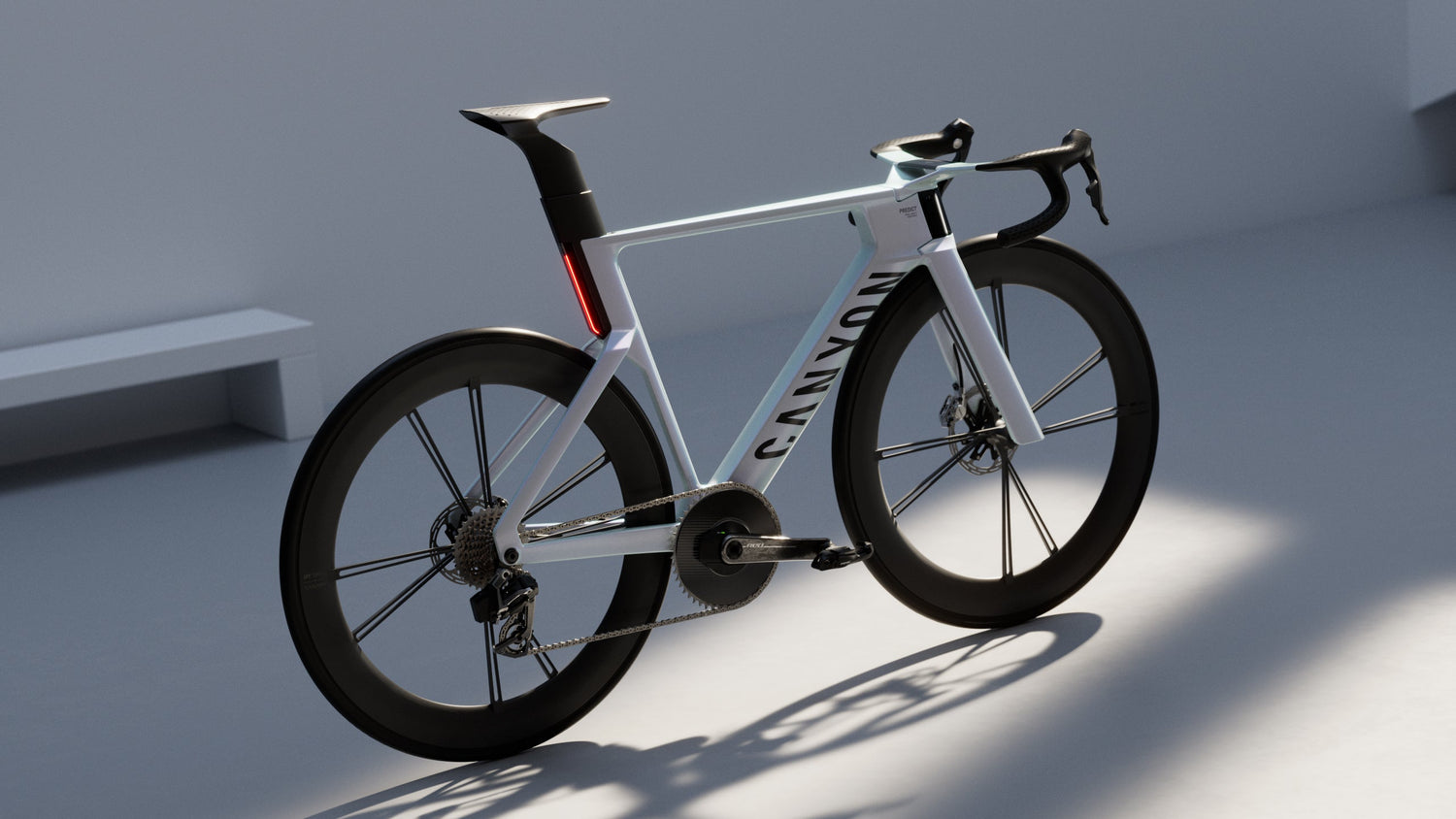
At Eurobike, which runs June 24 to 27, Canyon unveils a prototype called the Predict. Strip away the launch-day adjectives and here is what it is: a road bike wearing a 360-degree sensor array, the kind of perception hardware that has been living on the roofs of autonomous cars for a decade now bolted to a frame that weighs a fraction of one. The system watches the road the rider cannot. It reads approaching vehicles, tracks the churn of a group ride, advises on cornering speed, and flags a slick or broken surface before the front wheel finds it.
The Predict talks to a second piece of the puzzle, an augmented-reality helmet called the Stingr, which drops a visor with a data screen into the rider's eyeline. So the bike senses, the helmet shows, and the rider, in theory, descends an unfamiliar Alpine hairpin already knowing what waits on the far side of the apex.
It does not arrive alone. Canyon is also showing the Roadlite:ON CF, a near-production e-city bike built with Volkswagen's vehicle-to-everything communication tech, plus a cross-country mountain bike rolling on 32-inch wheels. The Predict is the one that matters, because the Predict is the one carrying an argument.
The argument is a century old
Cycling has always dreamed of the machine that protects its rider, and cycling has always flinched at the result.
In 1933, a Frenchman named Francis Faure climbed aboard a recumbent designed by Charles Mochet, the Vélocar, and broke a one-hour record that had stood for twenty years. The bicycle was faster because the position was smarter. The UCI's response in 1934 was to ban the recumbent from competition and redefine what a bicycle was permitted to be. Mochet's machine worked too well, so the sport ruled it out of existence. Boardman's Lotus met the same fate sixty years later. The pattern holds with depressing reliability: an outsider builds something that reads the physics correctly, the establishment admires it, and then the rulebook closes around it.
The Predict steps directly into that tradition, and it raises the stakes, because this time the machine promises something heavier than speed. This time it claims to think. A sensor that advises your cornering speed is making a judgment that has belonged to the rider's nerve and experience since the first descent of the first mountain pass. A peloton that has spent a hundred and forty years guarding the purity of human effort now has to decide whether a bike that anticipates the road is a safety device or a co-pilot.
Why it lands now, and why it lands hard
The timing is not an accident. Rider safety is the loudest conversation in the professional sport right now, from barrier design to course vetting to the running fight over in-race technology and rider radios. Canyon, a direct-to-consumer brand from Koblenz with no WorldTour bike-supply legacy to protect, has every commercial reason to plant a flag in that debate and own the headline. A concept bike costs a fraction of a sponsored team and buys ten times the trade-press oxygen. Expect every outlet in the building to file the same spec summary by Wednesday lunchtime.
The interesting piece is the one the spec summary misses. Canyon has built the prototype that finally answers cycling's oldest fantasy, the bike that sees for you, and in doing so it has walked straight onto the same ground that swallowed the Vélocar and the Lotus 108. The governing body will eventually have to rule on whether predictive assistance belongs in a race, and history suggests it will say no, then spend a decade arguing about it.
That is the story worth watching in Frankfurt. The sensor count and the helmet visor will be obsolete inside three seasons anyway. The thing to watch is the moment a mainstream brand decided to test how much intelligence the sport will tolerate in a machine that is supposed to be powered by nothing but legs. Boardman's Lotus got one Olympic cycle before the door shut. The Predict is betting the door has finally been propped open for good. Cycling has taken that bet before, and cycling usually wins.
Image: Canyon