Picture the scene - A pallet comes shrink-wrapped and crushed at one corner, the entry summary in a plastic sleeve stapled to the top carton, gone soft from three days on a dock. You're standing in a warehouse with box cutter in hand. The frames are fine but the number at the bottom of the paperwork has moved a long way from what I put in the spreadsheet in April...
That gap is the whole story of the American bicycle trade in 2026, and it has a date on it. On 24 July, a new round of Section 301 tariffs took effect on imports from sixty countries, which between them account for 99.4% of everything the United States buys from abroad. Bicycles, e-bikes, frames and components are all inside it, because the industry's manufacturing map is Taiwan, China, Vietnam, Cambodia, Thailand and Indonesia, and every one of those countries is on the list.
The route to that date was messy. In February the Supreme Court found the administration's use of emergency powers to impose reciprocal tariffs unlawful. The response was a pivot to Section 122 of the Trade Act, which permits a flat 10% global surcharge and expires automatically after 150 days. That clock ran out on 24 July. To keep something in place, USTR opened Section 301 investigations into sixty trading partners on the question of whether each one prohibits and enforces against the import of goods made with forced labour. All sixty were found wanting in some degree, and the finding produced a two-tier duty of 10% or 12.5% depending on how a country was judged and whether it had made commitments under the Agreement on Reciprocal Trade.
What that means at the entry line is worth spelling out, because the aggregate figures conceal how unevenly it lands. Vietnam and Thailand both drew the 12.5% tier, stacked on top of the existing most-favoured-nation rate. A bike carrying a 5.5% MFN duty now clears at 18%. An 11% bike clears at 23.5%. Parts sitting at 10% go to 22.5%. Cambodia and Indonesia landed in the 10% tier, so the same three lines run 15.5%, 21% and 20%. China is the severe case, because the Section 301 duties from 2018 remain in force at roughly 25% on most bike categories and compliance guidance so far assumes the new 12.5% stacks on top of them. On that reading a 5.5% Chinese bike arrives at 43%, an 11% bike at 48.5%, and parts anywhere from 37.5% to 47.5%. Chains and other steel and aluminium components carry Section 232 duties as well, which pushes them past 50%.
Taiwan is the exception, and it is the exception that tells you what the schedule is actually for. Taiwan made forced-labour commitments under ART, and its treatment works by calculation to a ceiling. Where a product's MFN rate falls below 10%, the Section 301 duty is set so that the two together total exactly 10%; where the MFN rate already meets or exceeds 10%, the Section 301 duty is zero. So a Taiwanese frame at 5.5% goes to 10% flat, and a Taiwanese bike already at 11% stays at 11% with nothing added. Because the old Section 122 surcharge stacked and has now disappeared, importers bringing high-end product out of Taichung will pay slightly less this autumn than they did in June. The European Union gets the same arrangement. Nobody else does.
Seventy-one years ago this month, the same instrument produced almost the same shape. On 14 July 1955 the Tariff Commission sent President Eisenhower a supplementary report on bicycles, finding that domestic sales continued to deteriorate and that escape-clause relief was justified. American manufacturers had spent years watching British three-speeds arrive on the docks and take the enthusiast end of the market, and they had asked for protection under the escape clause of the trade agreements programme. On 18 August, Eisenhower accepted most of what the Commission recommended and raised the ad valorem rate on most imported bicycles from 15% to 22.5%.
He did not accept all of it. For large-wheel lightweight bicycles, the category that actually mattered to the riders doing the importing, the Commission had recommended the full 22.5% and Eisenhower set it at 11.5% instead, up from 7.5%. The good bikes got protected from the protection. Seven decades later, the country that builds the good bikes is the one holding a calculated 10% ceiling while Vietnam absorbs 18%. The mechanism changes its paperwork and keeps its instincts.
The British reaction in 1955 was loud. Ambassador Aldrich cabled Washington about the effect on Anglo-American trade relations, and the British government delivered a strongly worded aide-mémoire making the same point at greater length. And then the thing that always happens happened. The National Bureau of Economic Research, going back over the period afterwards, found that the only structural change in bicycle imports was a temporary dip in British product, displaced by cheaper models from Holland and Germany. The duty rearranged the flags on the customs declarations and left the volume more or less intact.
Schwinn's great decades came anyway, and they came from the dealer franchise system, from the Sting-Ray, from the company's willingness to spend on advertising and to control who was allowed to sell its bikes. The tariff was ambient weather. The moat was commercial. That distinction is the useful inheritance from 1955, and it is worth carrying into a season where the landed-cost conversation threatens to swallow everything else.
Which is why the reasonable posture right now involves knowing more about your own product than you have previously needed to. The HTS line matters, since e-bikes sit under heading 8711 and analogue bikes under 8712, with different baseline duties and therefore different totals under the same country tier. Origin matters in a way that has become deeply technical: a frame welded in Cambodia paired with a Chinese motor and a Chinese battery is a different customs problem from a Cambodian bike with a Japanese drivetrain, and the tariff stack is assembled component by component. The UK extended its anti-dumping duty on China-origin bicycles and parts through 2029 on 19 August, which closes off the reroute that some brands were quietly modelling. And USTR still has a parallel investigation open into industrial overcapacity covering China, the EU, Japan and Taiwan, so the Taiwanese advantage described above has a shelf life nobody can quote.
The riders will not notice most of this, and that is appropriate. What they will notice is the price of a good frameset in the spring, and whether the shop that sold it to them is still there in two years. The 1955 duty is now a line in an economic history paper, while the Raleigh Sports it was written against is remembered fondly by people who have never seen a tariff schedule in their lives. Somewhere in Taichung this week, somebody is quoting a frame for a 2027 order book, and the number will be shaped by a forced-labour finding published in Washington in July. Both of those things are true, and only one of them will still be interesting in fifty years.
---
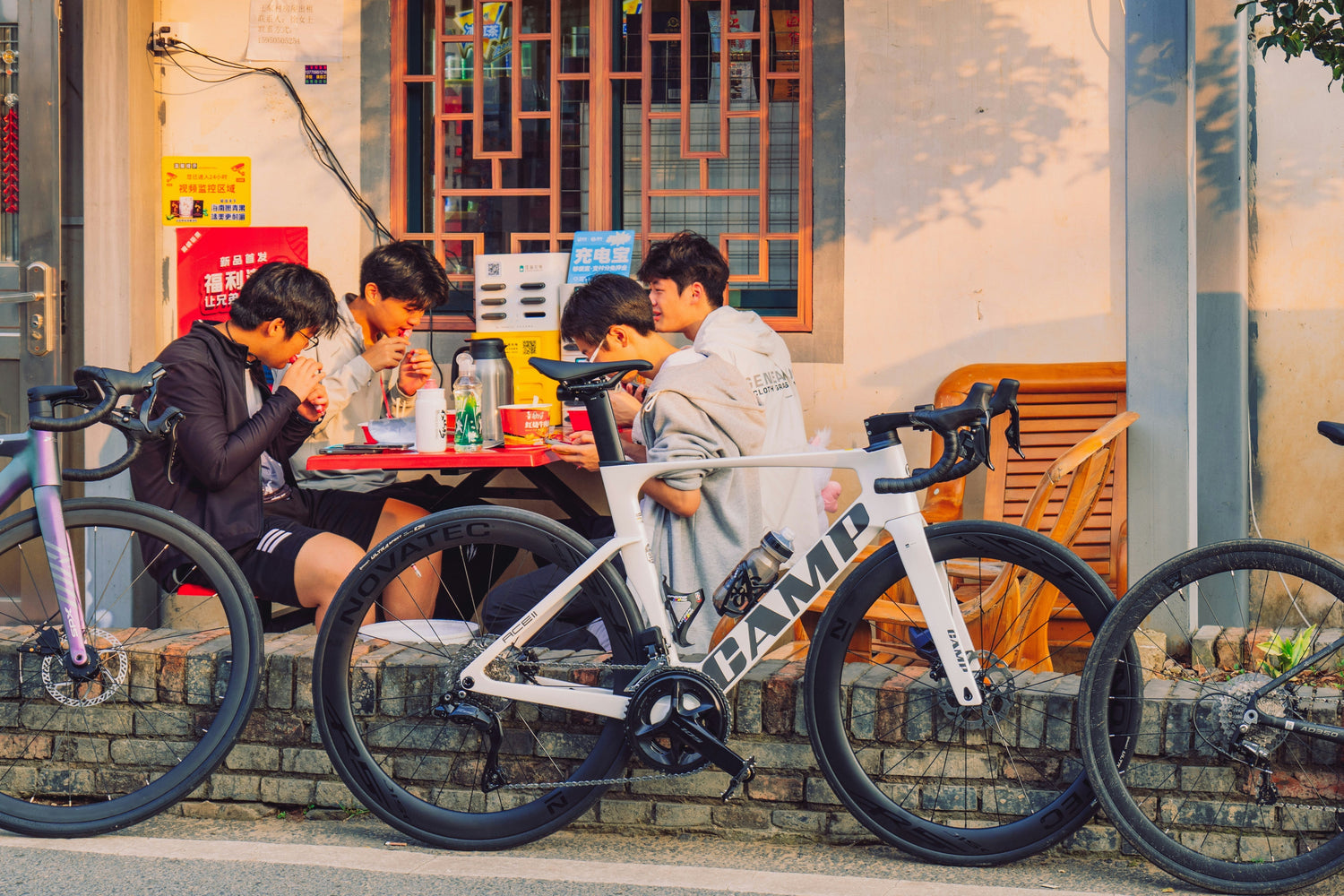
Photo by Aasing Gwok on Unsplash
_Sources: [Oerus Supply Chain Solutions, "New U.S. Tariffs Just Hit the Bike Industry"](https://oerus.com/oerus-blog/2026/7/24/new-us-tariffs-just-hit-the-bike-industry-heres-a-quick-breakdown) · [PeopleForBikes, 2026 Bike Industry Trade and Tariff Updates](https://www.peopleforbikes.org/news/2026-bike-industry-tariff-updates) · [Oerus, UK anti-dumping duty extension](https://oerus.com/oerus-blog/2026/8/19/uk-anti-dumping-duty-on-china-origin-bicycles-and-components-to-continue-until-2029) · [Foreign Relations of the United States, 1955-57, vol. IX](https://history.state.gov/historicaldocuments/frus1955-57v09/d37) · [NBER, tariff and import structure chapter](https://www.nber.org/system/files/chapters/c13861/c13861.pdf)_