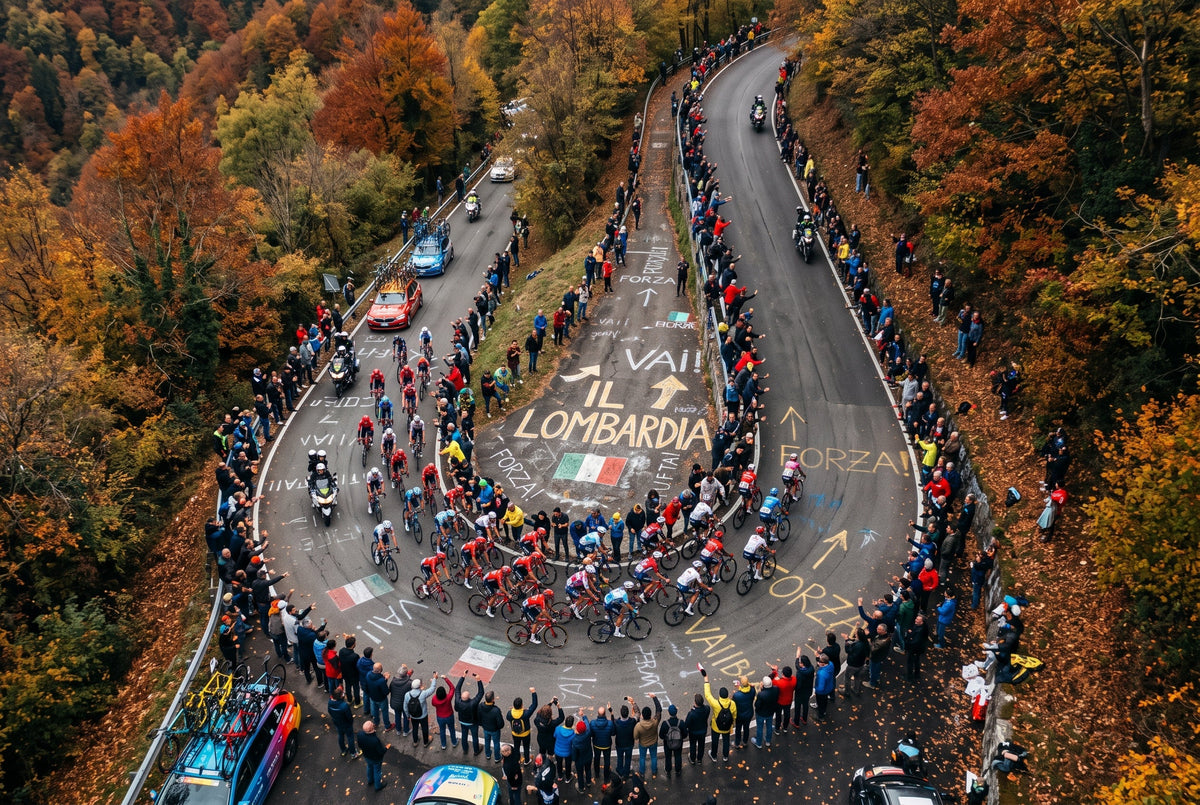
Nobody who has ridden the Lombardy hills in the last week of the season would call the weather an accident. The race that finishes here was invented for exactly this light.
Il Giro di Lombardia ran for the first time in 1905, and somewhere along the way it picked up the name that suits it best: the Race of the Falling Leaves. It closes the season's great one-day races, the last Monument before the peloton scatters to training camps and criterium appearance fees. This Saturday, 10 October, it runs for the 120th time, 239 kilometres from Bergamo to Como. The organisers have flipped the direction for 2026, so the riders who know every corner from the other side will meet them in reverse, and the finale takes in a double ascent of San Fermo della Battaglia before the road falls to the lake.
The usual owner of this race will be at home with a broken collarbone. Tadej Pogačar won it five years running, 2021 through 2025. Fausto Coppi, whose name sits at the head of the record book, won it five times across a career, four of them in a row from 1946 to 1949 and the fifth in 1954 after the race had passed through other hands for four seasons. Pogačar matched Coppi's total and beat his streak, and then a crash at the Vuelta put him on the sidelines for the defence of the title. The start list is therefore the first open one in half a decade.
Remco Evenepoel arrives as the obvious candidate, third here last year behind the man who is now absent. He also arrives with a fresh European champion's jersey. On Monday in Slovenia he went down on the fourth climb of the Možjanca, remounted, attacked with 32 kilometres to go and beat Giulio Ciccone by roughly two centimetres in a photo finish, after Ciccone had built a seven-metre lead with 300 metres left. Evenepoel said the win completed his collection of major championships. A rider who has just finished a collection tends to hunt the next shelf, and the Monument that most resembles a long weekend of attacking (239 kilometres, the climbs stacked toward the end, a flat-out descent into town) is the obvious one to want.
An open Lombardia has more history on its side than a closed one. Coppi's reign lasted four editions and then the race belonged to other people for four more, and those are the editions that tell you what the race is when its champion is elsewhere: a long day on cold roads that rewards whoever has the legs and the nerve for the descent, with leaves on the tarmac and a lake at the bottom. Pogačar's five wins turned it into a procession of one. Without him the road may behave the way it did for most of its first century, as a place where a dozen riders can quietly believe they are going to win until the last climb tells them otherwise.
The kit worth owning for this weekend is what the roads ask for: a proper gilet, a wind-stopping base layer, thin gloves under a thicker pair, and a decent pair of overshoes for the first wet morning. Put an alarm on Saturday for the start from Bergamo, ride a loop of your own before the finish so the legs have a story to tell the television, and then settle in for the last hour with the leaves still on your jersey.
Sources: Cyclingnews race page, We Love Cycling on the European Championships